Computes DPIT residuals for regression models with negative binomial
outcomes using the observed counts (y) and their fitted distributional
parameters (mu, size).
Details
For formulation details on discrete outcomes, see dpit.
Examples
## Negative Binomial example
library(MASS)
n <- 500
x1 <- rnorm(n)
x2 <- rbinom(n, 1, 0.7)
### Parameters
beta0 <- -2
beta1 <- 2
beta2 <- 1
size1 <- 2
lambda1 <- exp(beta0 + beta1 * x1 + beta2 * x2)
# generate outcomes
y <- rnbinom(n, mu = lambda1, size = size1)
# True model
model1 <- glm.nb(y ~ x1 + x2)
y1 <- model1$y
fitted1 <- fitted(model1)
size1 <- model1$theta
dpit.nb1 <- dpit_nb(y=y1, mu=fitted1, size=size1)
resid.nb1 <- residuals(dpit.nb1)
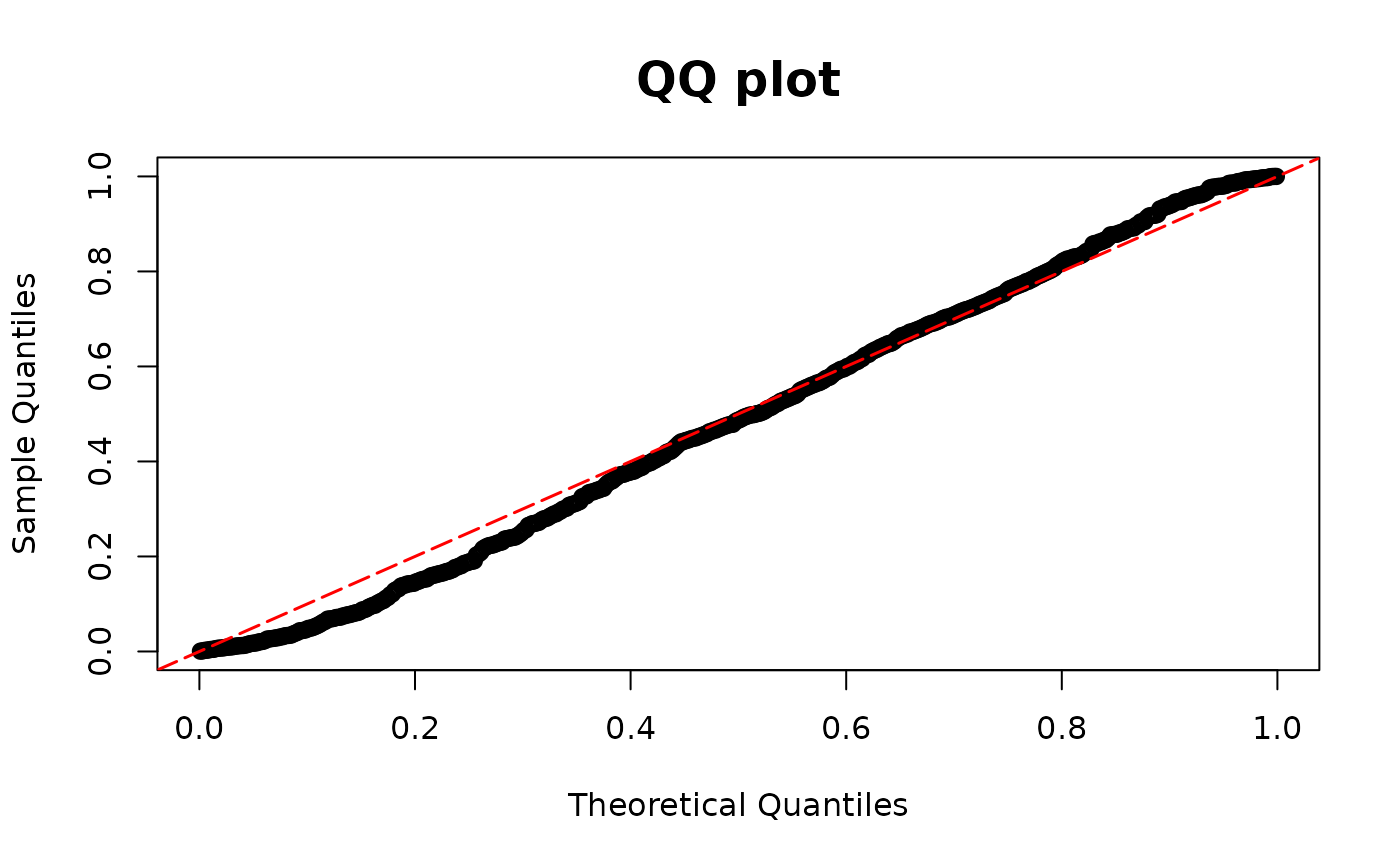
plot(dpit.nb1)
 # Overdispersion
model2 <- glm(y ~ x1 + x2, family = poisson(link = "log"))
y2 <- model2$y
fitted2 <- fitted(model2)
dpit.nb2 <- dpit_pois(y=y2, mu=fitted2)
resid.nb2 <- residuals(dpit.nb2)
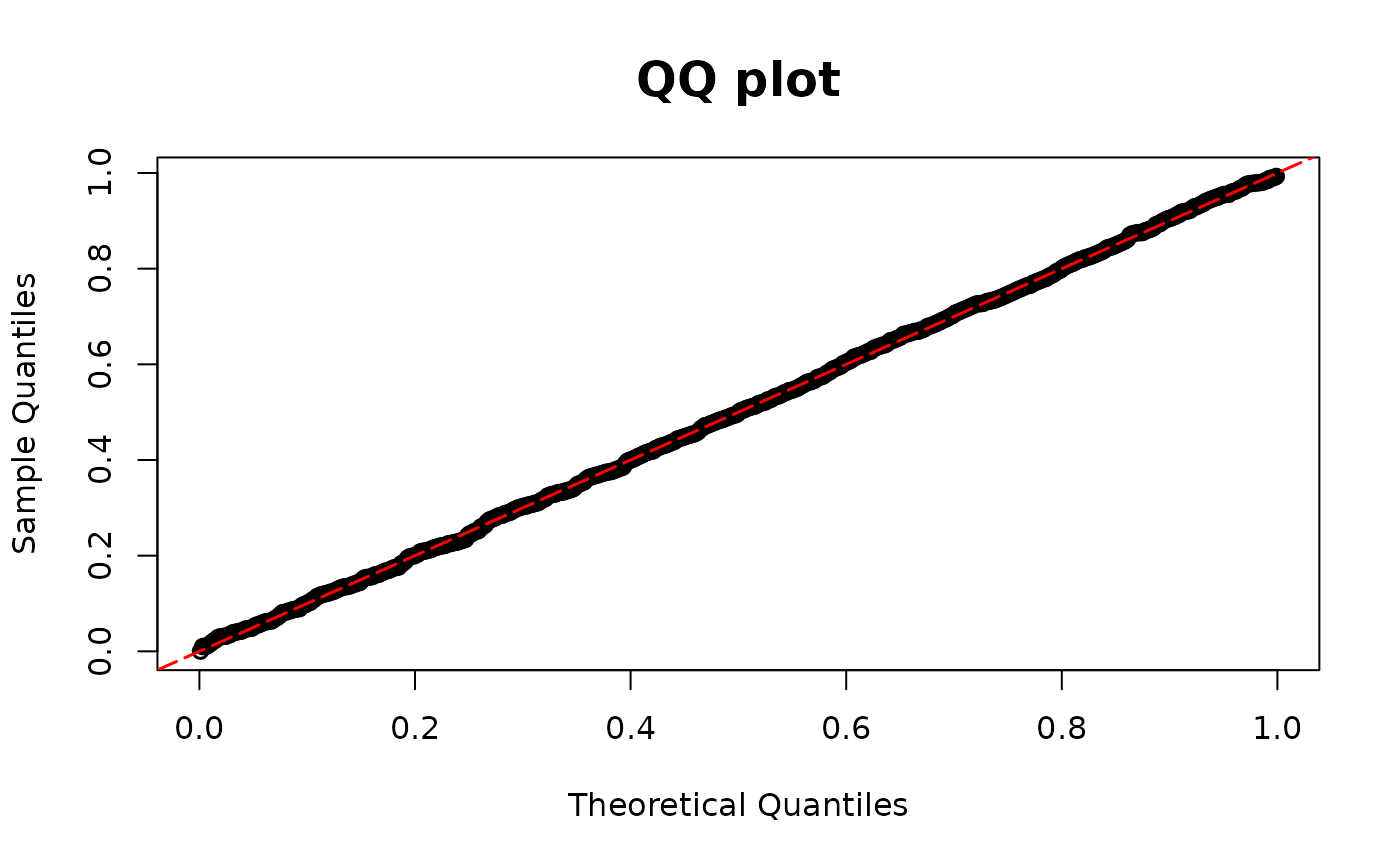
plot(dpit.nb2)
# Overdispersion
model2 <- glm(y ~ x1 + x2, family = poisson(link = "log"))
y2 <- model2$y
fitted2 <- fitted(model2)
dpit.nb2 <- dpit_pois(y=y2, mu=fitted2)
resid.nb2 <- residuals(dpit.nb2)
plot(dpit.nb2)