Residuals for regression models with zero-inflated negative binomial outcomes
Source:R/dpit_znb.R
dpit_znb.RdComputes DPIT residuals for regression models with zero-inflated negative
binomial outcomes using the observed counts (y) and their fitted distributional
parameters (mu, pzero, size).
Details
For formulation details on discrete outcomes, see dpit.
Examples
## Zero-Inflated Negative Binomial
library(pscl)
#> Classes and Methods for R originally developed in the
#> Political Science Computational Laboratory
#> Department of Political Science
#> Stanford University (2002-2015),
#> by and under the direction of Simon Jackman.
#> hurdle and zeroinfl functions by Achim Zeileis.
n <- 500
set.seed(1234)
# Covariates
x1 <- rnorm(n)
x2 <- rbinom(n, 1, 0.7)
# Coefficients
beta0 <- -2
beta1 <- 2
beta2 <- 1
beta00 <- -2
beta10 <- 2
# NB dispersion (size = theta; larger => closer to Poisson)
theta_true <- 1.2
# Mean of NB count part
mu_true <- exp(beta0 + beta1 * x1 + beta2 * x2)
# Excess zero probability (logit)
p0 <- 1 / (1 + exp(-(beta00 + beta10 * x1)))
## simulate outcomes
z <- rbinom(n, size = 1, prob = 1 - p0) # 1 => from NB, 0 => structural zero
y1 <- rnbinom(n, size = theta_true, mu = mu_true) # NB count draw
y <- ifelse(z == 0, 0, y1)
## True model
modelzero1 <- zeroinfl(y ~ x1 + x2 | x1, dist = "negbin", link = "logit")
y1 <- modelzero1$y
mu1 <- stats::predict(modelzero1, type = "count")
pzero1 <- stats::predict(modelzero1, type = "zero")
theta1 <- modelzero1$theta
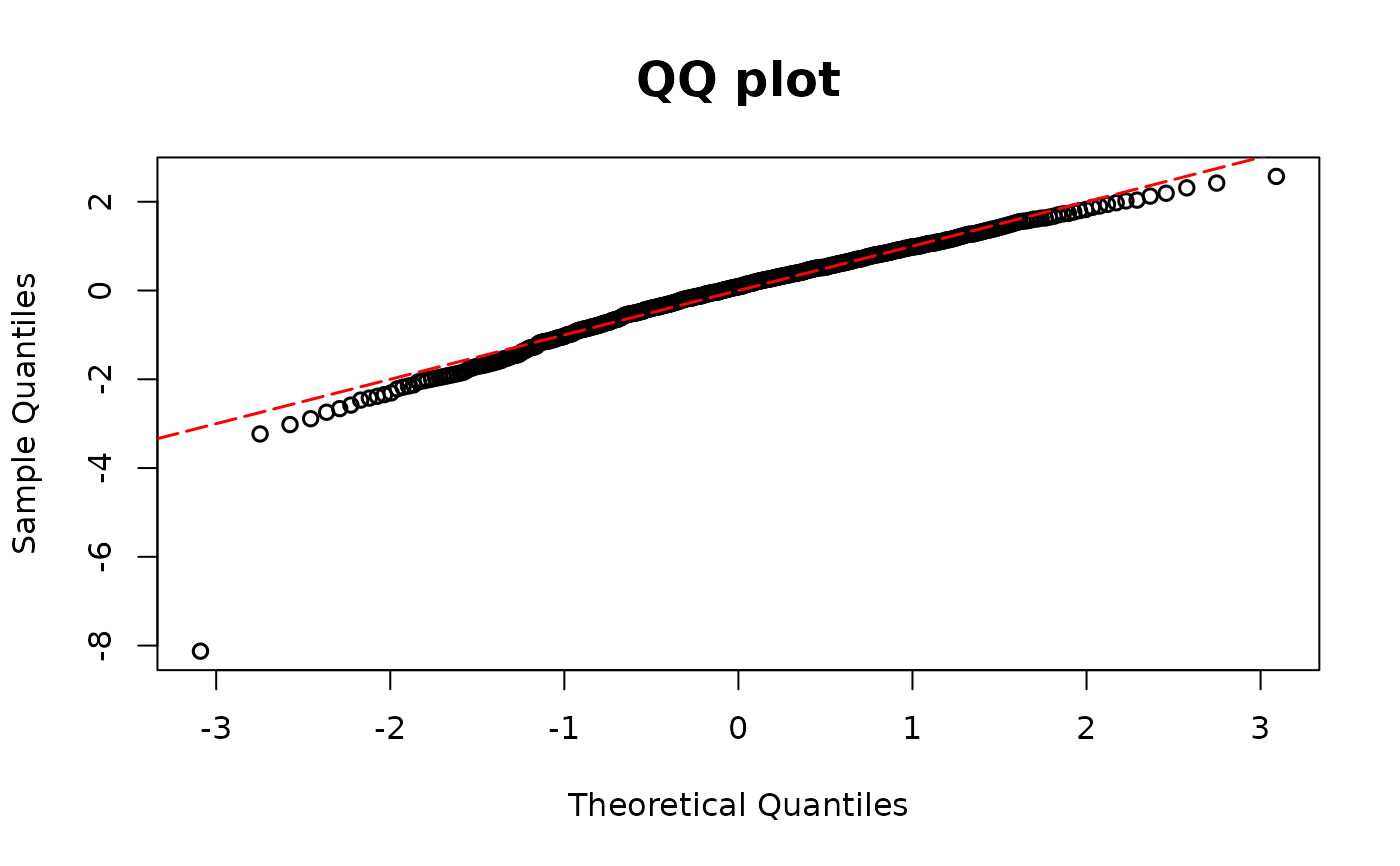
dpit.zero1 <- dpit_znb(y = y1, pzero = pzero1, mu = mu1, size = theta1)
resid.zero1 <- residuals(dpit.zero1)
plot(dpit.zero1)
 ## Ignoring zero-inflation: NB only
modelzero2 <- MASS::glm.nb(y ~ x1 + x2)
y2 <- modelzero2$y
mu2 <- fitted(modelzero2)
theta2 <- modelzero2$theta
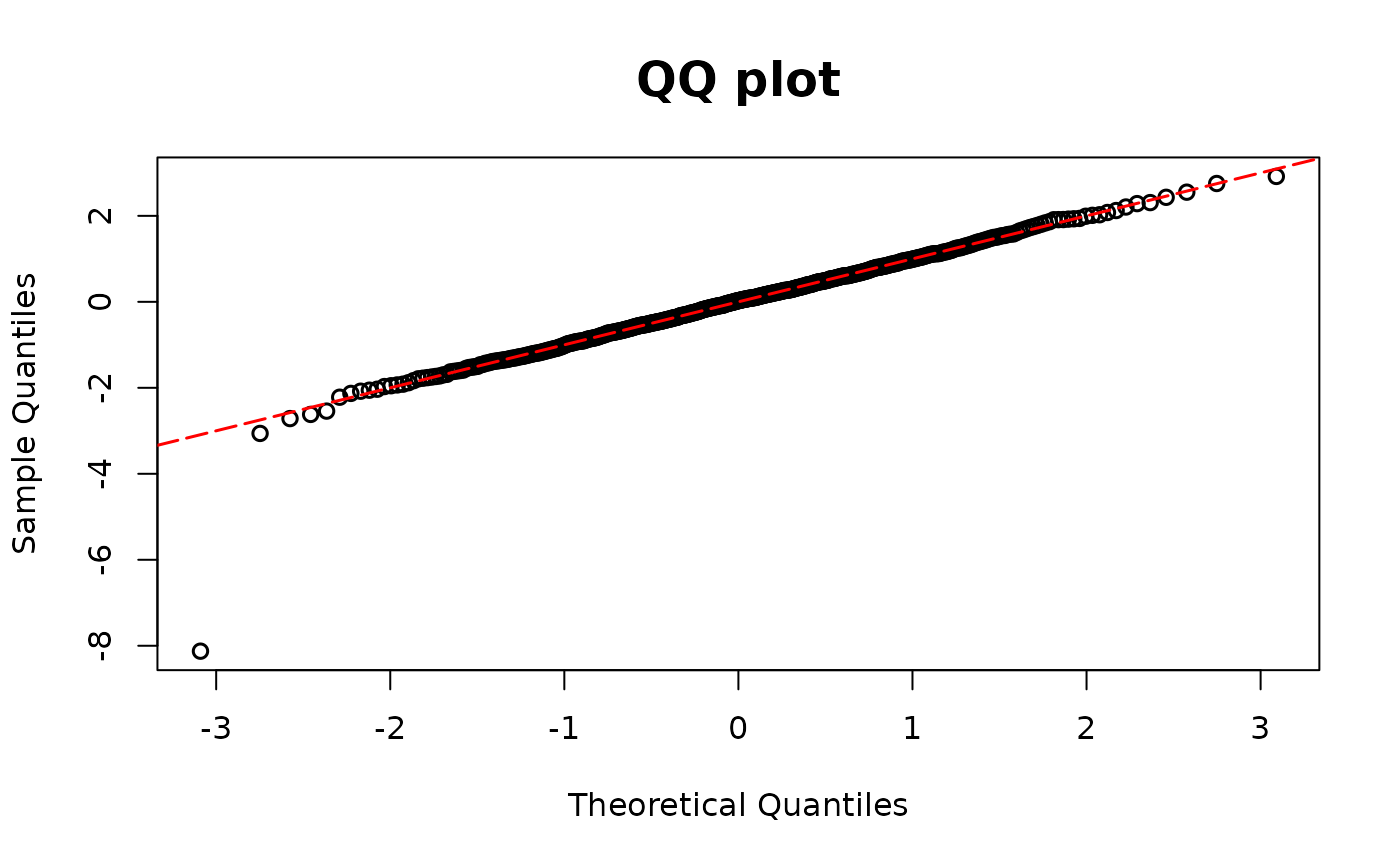
dpit.zero2 <- dpit_nb(y = y2, mu = mu2, size = theta2)
resid.zero2 <- residuals(dpit.zero2)
plot(dpit.zero2)
## Ignoring zero-inflation: NB only
modelzero2 <- MASS::glm.nb(y ~ x1 + x2)
y2 <- modelzero2$y
mu2 <- fitted(modelzero2)
theta2 <- modelzero2$theta
dpit.zero2 <- dpit_nb(y = y2, mu = mu2, size = theta2)
resid.zero2 <- residuals(dpit.zero2)
plot(dpit.zero2)